

When You Say Freediving, You Say Cetma Composites

Cressi: Gara Turbo Impulse
4 September 2026
Salvimar: Antares Dive Light
21 September 2026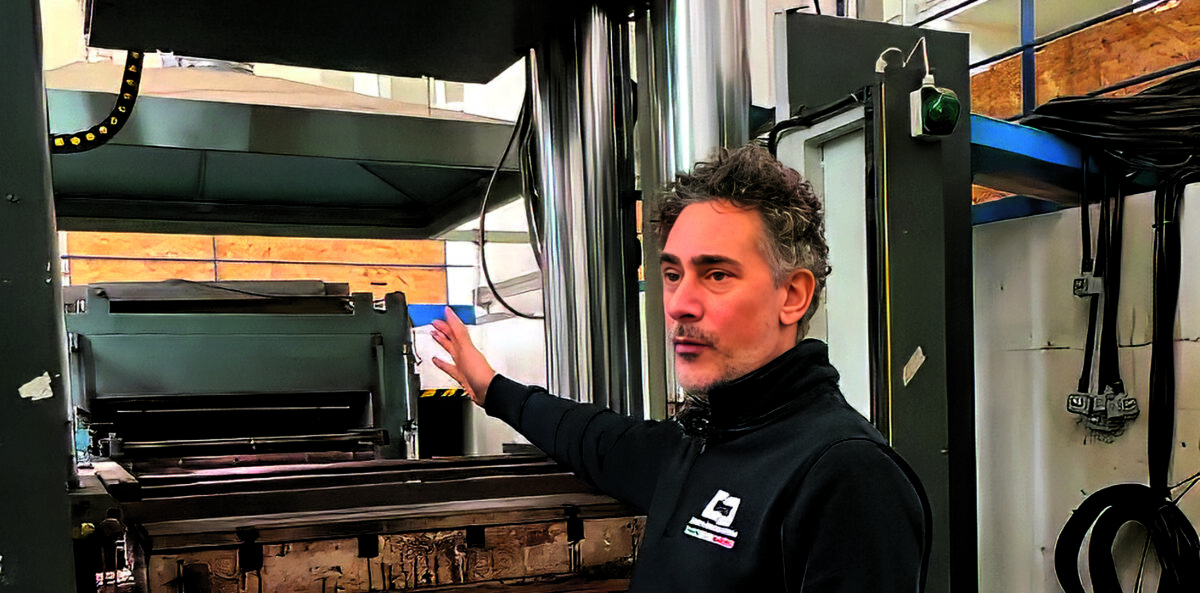
Masterpieces! That is perhaps the best way to describe the composite fins produced by this company from Puglia, whose flagship product is the Taras: a “missile” strapped to the feet of most top-level athletes, helping them achieve around one hundred national and international records across the various disciplines. But that is not all. Over the years, the company has expanded its catalogue and now includes, alongside several families of fins, an extensive range of spearguns. The secret? A huge amount of work and even more research and development, as Andrea Salomi explains
Sometimes you don’t need too many words; numbers are enough. And in this case, the numbers speak clearly: more than 100 world and national records achieved across the various freediving disciplines. Total, absolute dominance, and it has a very specific name: Taras. The fin that for several seasons now has been dominating the most important competitions on all five continents. There is hardly a top-level athlete who does not wear them. A “monopoly” that, at this level, has no equivalent in any other sport.
“For years, people have been trying to copy them, to take inspiration from the Taras, but nobody has ever succeeded. The fact that the vast majority of top athletes continue to choose them proves it,” Andrea Salomi tells us. He is one of the creators of Cetma Composites, as well as the father of this “perfect machine.”
Cetma Composites has grown significantly in recent years thanks to the Taras, certainly, but not only. We are now talking about a market-leading company with a comprehensive catalogue of high-end products. In addition to composite and polymer fins—which remain its main focus—it offers a truly complete range of spearguns, including the Shark, Canova and Seabull. All products that have achieved remarkable success. To realise just how successful they are, you only had to visit the Cetma stand at the latest Eudi Show; it was difficult even to get inside! Enthusiasts, athletes and industry professionals alike were all curious to take a look at the latest developments.
In short, this is a truly “all-round” company, which now has nothing to envy from the leading players in our industry. It has grown and become increasingly structured season after season, thanks to major investments and strategic choices that have proved successful.
Andrea is a friend before he is a client, which is why whenever I happen to be in the Brindisi area, I always stop by to say hello. And every time I find something new, something more than on my previous visit. On the large tables in the “clean rooms”, the Taras and Mantra fins and the new Pulse are assembled, while in a separate area some Taras monofin components are being finished. This is another product that is collecting medals all over the world.
In a slightly more secluded section there are two large “containers.”
“They’re refrigerators,” Andrea explains. “The pre-impregnated carbon fibre has to be stored at 17 degrees below zero, and it must only be taken out of these refrigerators when it needs to be processed.”
This is done using two automated machines located in an adjacent room.
Andrea then shows us the autoclave where the blades are manufactured and explains how they have managed to optimise production.
“The void content, and therefore the number of defects, in our products is zero. That’s something we are very proud of.”
He is also keen to point out that “the blades and gun barrels are not painted. The glossy transparent coating often used in this industry is a trick used to conceal voids and surface defects.”
Meanwhile, one of his colleagues shows him a freshly finished Taras blade: it is beautiful, with an impeccable finish.
It is an impressive, well-organised facility, with several people working there. But that is not all. Adjacent to the first building is a second warehouse, acquired because more space was needed. Various materials and a large machine are stored there.
“It’s a multi-axis machining centre,” Andrea explains. “It is used to manufacture moulds in steel and alloy.”
Upstairs are the offices, where Silvio Pappadà, the other partner in Cetma Composites, is busy with some suppliers.
“Besides the two of us, there are Giuseppe and Alessandra. With the exception of Giuseppe, we are all materials engineering researchers. Giuseppe, on the other hand, was a production manager at a company involved in composites for the sports sector.”
Andrea holds a degree in materials engineering and a PhD in mechanical engineering, and has spent periods studying and working abroad, collaborating with major institutions such as the Aerospace Engineering Department at the University of Bristol and the Fiat Research Centre. Silvio and Alessandra have followed a similar path.
“It’s almost one o’clock. Let’s go and grab something to eat,” Andrea suggests.
Meanwhile, we continue chatting, and the conversation turns to what led him to work in this field.
“Ever since I was a kid, from when I was six or seven years old, I used to follow my older brother out to sea. But my real passion was always diving equipment. I would take everything apart, modify it, rework it hundreds of times. We started with the classic spring-loaded Polpone and rubber fins, which I was already modifying back then. I had blue Rondine fins, which were positively buoyant, while my brother used the black ones, which were negatively buoyant. I started tinkering with them even then. So, by the time I was 15 or 16, I was modifying the pneumatic spearguns belonging to our friends.”
And when did you get the idea of creating Cetma Composites?
“For about fifteen years I worked in applied research. That means I carried out research aimed at improving or developing companies’ products. At a certain point, together with Silvio, a colleague and great friend, we decided to take the leap, pursue our own project and create Cetma Composites.
“We immediately thought about putting together a team with complementary skills. Our business idea was to ‘look for’ composite products and redesign them using an engineering approach—the same approach we had worked with for many years for companies in the aerospace, automotive and other sectors.”
And you started with fins…
“Before starting, we conducted market research. Among the many products that had room for development, carbon fins were highlighted to us.
“They had been known on the market for about twenty years, but they had always remained largely artisanal products, meaning that very little had been done from a materials-engineering perspective.
“That, in essence, was what emerged from the market research. So we got started.”
During our conversation, Andrea dwells on a concept that catches my attention: the “engineered distribution of stiffness.” I ask him what it means.
“It is an engineering method that we were the first to apply to fins. Using the theory of composite-material mechanics, it is possible to design a fin by distributing stiffness along the blade in such a way that it deforms in the desired manner during the finning cycle—in other words, in the most hydrodynamically efficient way possible.
“In practice, you start by deciding how the fin should deform in order to achieve maximum hydrodynamic efficiency. This is also done with the help of dedicated software. Then, once the shape that the blade needs to assume—the deformation curve—has been established, you design its stiffness so that this shape can be reproduced during operation.
“Differential stiffness means, precisely, that the blade can be divided into many zones, each with a different stiffness. Essentially, stiffness varies along the entire length of the blade, allowing it to deform according to the design.
“This is achieved mainly by varying the thickness, the type of material—carbon fibre with different moduli—and the fibre orientation.
“This means that we are not simply talking about a variation in thickness, but a genuine variation in the material’s elastic modulus.
“And this is where the difference between our product and a traditional, artisanal product becomes apparent. Changing the fibre orientation in the laminate sequence of a composite requires specific expertise in composite-material mechanics. Otherwise, you risk premature and sudden blade failure, as well as annoying problems with twisting and malfunction.”
And what can you tell us about the resonance system?
“To be precise, it is called DRS, Dynamic Resonance System, and we invented it about ten years ago.
“In the past, while working on the design of a car passenger compartment, we came across some modal analyses. Once the structure had been designed, we had to make sure it would not resonate with the oscillation frequencies generated by engine operation. We were later asked to perform this type of analysis in other fields as well.
“Resonance is a well-known phenomenon in nature. Practically any structure, if ‘excited’ at certain frequencies, will resonate, generating an amplification effect in its oscillations.
“This is generally an undesirable phenomenon, so when designing these structures you have to ensure that it is avoided. At the end of every design process, a so-called ‘modal’ analysis of the structure is carried out.
“If it turns out that the structure will resonate, it has to be redesigned by redistributing mass and stiffness.
“Once we understood these phenomena, the idea was to exploit them to our advantage in fin design. How? By distributing mass and stiffness along the blade in such a way that it resonates at the finning frequencies of the diver.
“Resonance is, in fact, a very efficient way of ‘vibrating’. In finning terms, this means that very little muscular energy is required to produce an oscillation.
“Of course, this does not mean that during a dive you necessarily have to seek out a specific finning frequency. Efficiency remains high even at frequencies close to the resonance frequency. We can therefore talk about a range of finning frequencies.
“The feeling you get with models featuring this technology is, in fact, that of a softer fin compared with the amount of propulsion it is capable of generating.”
How much do materials affect a fin’s performance?
“We need to make a premise. The properties of a composite depend not only on its composition but also on the manufacturing process. For example, the same material processed using two different processes will have different mechanical properties.
“The same applies to its fibre-to-resin composition. Every batch of material purchased must be tested in order to measure its actual mechanical properties. Those properties are then used for the design.
“If you don’t characterise the material, you cannot talk about engineering design. It would be like trying to design a house without knowing the mechanical properties of the concrete!
“This is taken for granted in many industries, such as aerospace and automotive, but not in the sports sector.
“At Cetma Composites, we use Japanese- or American-made high-modulus carbon and high-strength carbon prepreg materials—the best currently available on the market.
“The company that manufactures our prepreg does so according to one of our own formulations. And that is what sets us apart from other manufacturers.”
How important are testers and athletes in product development?
“Absolutely essential. At Cetma Composites we rely on the expertise of Michele Giurgola, who, in addition to being one of our ambassadors and an athlete, helps us throughout the various stages of development.
“With a fin, what matters is the relationship between performance and physical effort. When Michele started working with us, he told me that as soon as he began using our equipment, he was able to do four or five deep dives a day without his legs developing acidosis, which had not been possible before.
“We are talking about depths of between 70 and 80 metres, with incredible times—dives that at the time had only been attempted using a monofin.
“That is the real challenge: creating a high-performance fin that fatigues the legs as little as possible.
“To achieve this, we also work with most of the world’s top freedivers and almost all national teams. From Alenka Artnik to Abdel Alouach, from Vincenzo Ferri to Antonio Mogavero. As well as the strongest athletes in indoor disciplines.
“Finally, we also take advice from some very strong spearfishermen, who really put all our equipment through its paces.”
What is the main new product this year?
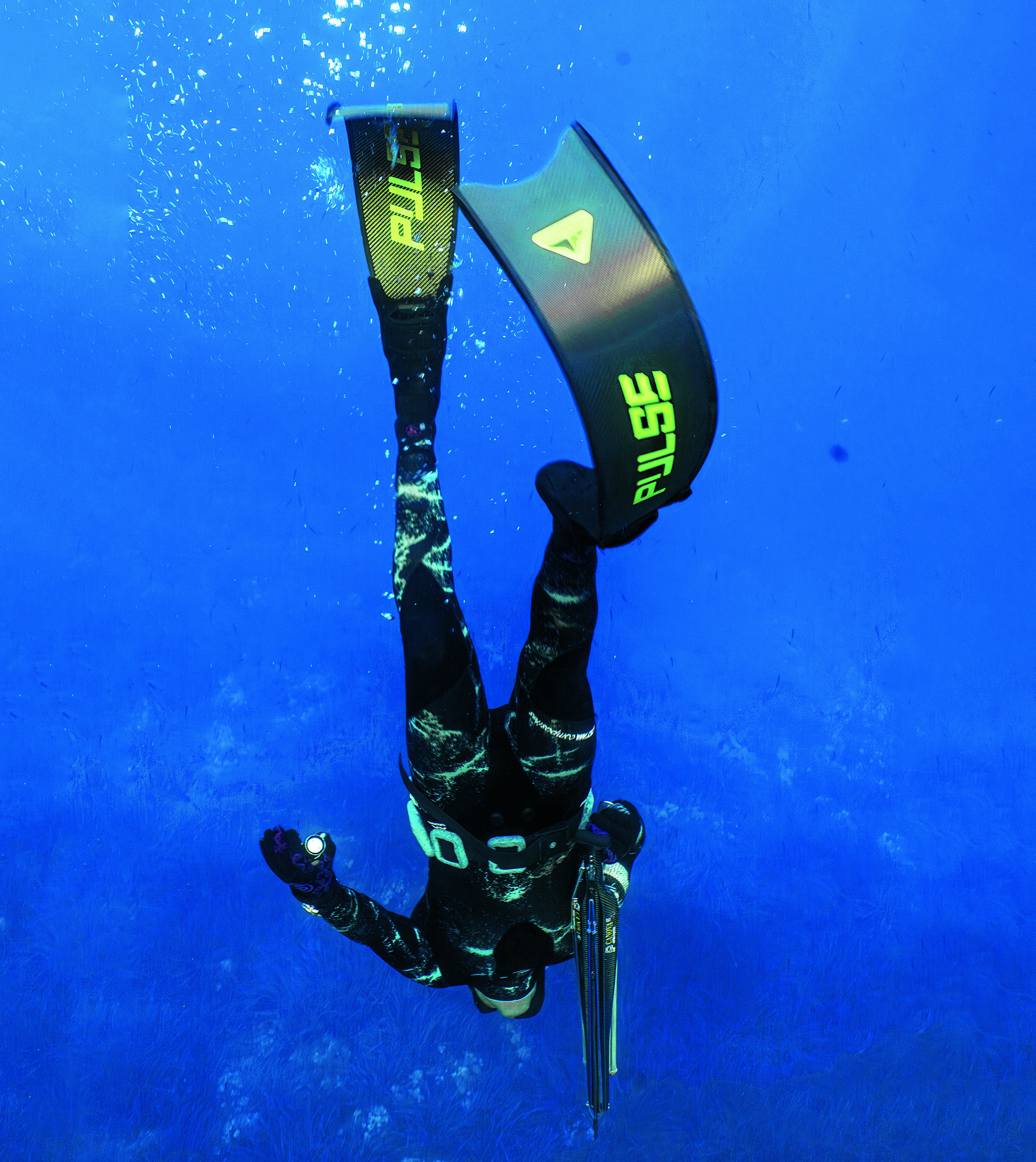
“Definitely the Pulse fin, which was presented at the last Eudi Show. “It has the same dimensions as the Prana, but in terms of performance it is very similar to the Mantra.
“We decided to mould the Pulse carbon blade in dimensions of 660 × 185 mm, specifically to meet the needs of those who fish in shallow water, where agility, manoeuvrability and speed of response are essential.
“The combination of two types of prepreg carbon has allowed us to create a blade with exceptional responsiveness—quick, explosive and extremely reactive.
“This characteristic also makes the Pulse suitable for deep dives, as well as dynamic apnea.
“The blade angle is more than thirty degrees and the foot pocket is the S-Wing. This means that the Pulse blade can be interchanged with other blades from the company.”
It is getting late and Andrea has other commitments. Before saying goodbye, however, I ask him one final question about the company and its history.
The story of Cetma Composites
“It all originated with the Cetma Consortium—the European Centre for Technologies and Materials—which, since 1994, has been involved in national and European research projects alongside some of the most prestigious companies in the aerospace and automotive sectors, as well as manufacturers of advanced materials.
“Its mission has been to transform research findings into real products or processes that companies can immediately put to practical use. In other words, technology transfer.
“Certainly, when it comes to polymer-matrix composites and polymeric materials, Cetma occupies an important position in Europe in terms of both the quantity and quality of the patents and know-how developed.
“One of the patents that is particularly close to my heart concerns the welding of carbon-fibre-based composites, a process that I invented together with Pappadà.
“In 2013, Cetma Composites Srl was established. Its corporate team includes internationally renowned researchers whose collective credentials include more than 200 publications in scientific journals, more than 100 presentations at national and international conferences, and more than 20 patents and registered designs.
“Since those early years, the company has continued to grow, carving out an important position on both the national and international stage.
“Above all, this has been thanks to our fins, and the Taras in particular. I want to stress that our competitors have studied them down to the smallest detail. But nobody has ever managed to match their performance.”